
Moondogs: Music & Halos
Moondogs:
The Blind Viking of Sixth Avenue & the Light Beside the Moon
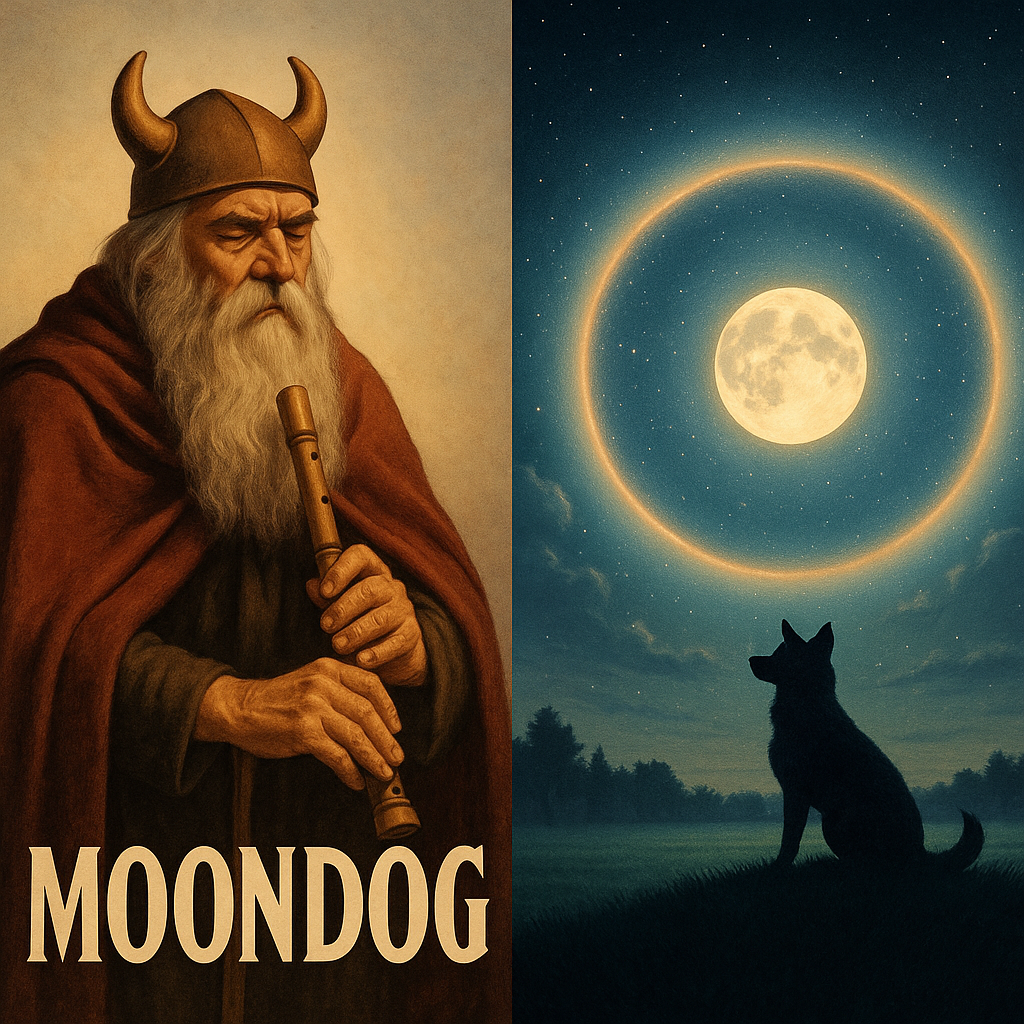
On a cold New York night in the 1950s, a man in a horned helmet stood on a Manhattan corner, selling sheet music and playing his own inventions. He was blind, tall, wrapped in furs, and known simply as Moondog. To some, he looked like a Norse god who had wandered into modernity; to others, he was a prophet of sound. In truth, he was Louis Thomas Hardin Jr. — a visionary composer whose life and music refracted the light of genius through the crystal edges of limitation.
The Man Who Heard in Patterns
Born in Kansas in 1916, Hardin lost his sight at sixteen after a blasting cap accident. Instead of dimming his world, blindness sharpened his ear. He learned music by touch and intuition, hearing rhythm in the rumble of trains, in footsteps, and in the chaos of city streets. When he moved to New York in the 1940s, he became a living legend — part street performer, part philosopher, part composer.
He called his rhythmic structure "snaketime", a pulse that moved with the freedom of a serpent rather than the strictness of a metronome. The visionary composer Moondog (born Louis Thomas Hardin) didn’t just compose his music—he also invented a remarkable array of instruments to realize it. Among his creations were the small triangular harp called the “oo,” a larger variant dubbed the “ooo-ya-tsu,” the triangular string instrument “hüs” (from the Norwegian hus, meaning “house”), and perhaps most famously the percussion instrument “trimba” – essentially a triangular drum structure combining cymbal and drums, which offered him unique rhythmic textures. Check them out here
The Name and the Myth
Moondog took his name from a beloved pet — a dog that howled at the moon back on his family’s farm. That image of loyal wildness stuck with him, and the name became his signature. He was both dog and moon: earthbound yet celestial, feral yet refined.
In a poetic twist, nature offers its own version of a "moondog." In atmospheric science, a moon dog is a pale halo or glowing patch of light that appears beside the moon, formed when moonlight bends through hexagonal ice crystals high in cirrus clouds. Moon dogs shimmer faintly, rare and spectral, their beauty often overlooked. They’re the night’s quiet echo of the more familiar sun dogs, those fiery halos that accompany the Sun.
Like the phenomenon, Moondog the man refracted light through what seemed like cold, invisible boundaries — blindness, loneliness, poverty — and turned it into radiance. Where others saw darkness, he created halos.
Legacy: The Halo That Never Fades
Throughout the 1950s and 60s, New Yorkers came to know him as the “Viking of Sixth Avenue.” He was a fixture of the streetscape, standing in his regal attire as taxis roared by, composing in his mind and selling records that would later inspire entire musical movements. In 1954, he even won a lawsuit against a radio DJ who had tried to steal his name — proof that even in a world built to overlook him, his identity could not be stolen.
In his later years, Moondog moved to Germany, where he continued composing until his death in 1999. His works — intricate canons, serene symphonies, and jazz-inflected miniatures — remain unlike anything else. They are pure Moondog: mathematical, mystical, deeply human.
The Lesson of the Moon Dogs
When you look up on a cold winter night and see two ghostly halos flanking the Moon — those are moon dogs, reflections of lunar light across frozen prisms in the sky. They’re a reminder that beauty often hides in diffraction, that brilliance comes from bending light, not competing with it.
So too was Moondog. He did not fight the limits of his life — he transformed them into an art form. He was the rare moon dog of humanity: a glimmer beside the Moon itself, proof that the periphery can be just as luminous as the center. His music remains a testament to defiant creation — to the howl in every heart that refuses silence. He showed us that light, no matter how faint, can always find its way through the frozen air.
On November 11, 2025—the one-year anniversary of Doggy K Care’s founding—I wanted to honor two guiding lights: a man whose creativity I deeply admire, and the moon, my celestial companion who joins me on my early morning walks. I’m endlessly grateful for the animals who have found their way into my life, for the shifting phases of the Moon that I watch with reverence, and for visionaries like Moondog, who remind us how to stay wildly weird, fiercely authentic, feral while refined, and beautifully balanced between the earth and the stars. 🌕🐺